Buyer Closing Costs CalculatorSeller Closing Costs CalculatorRealtor Commission CalculatorRent Vs. Buy Calculator
Discount Realtor®Cashback Realtor®Buyer Agent

Contact Us

2 Sheppard Avenue East, Unit: 20th Floor Toronto, ON M2N 5Y7 Canada

+1 (647) 228-0115

[email protected]

Support

  • Contact Us
  • Sitemap
  • Blog

Company

  • About PropertyMesh
  • Editorial Policy
  • Disclaimer
FacebookTwitterInstagramLinkedinYoutube
PropertyMesh

© 2026 All rights reserved. All registered trademarks herein are the property of their respective owners. PropertyMesh is owned by Faiza Ahmed Realty Corp. (RECO Registration #4791581) and operates under INTERNATIONAL REALTY FIRM, INC., Brokerage (RECO Registration #4799095).

Head Office: 2 Sheppard Avenue East Unit: 20th Floor Toronto, ON M2N 5Y7 Canada.

Privacy Policy·Terms & Conditions·

Data & Service Disclaimer:
Website Listings: PropertyMesh.ca provides access to live resale listings via IDX (Internet Data Exchange) and VOW (Virtual Office Website) feeds. This information is provided for consumers' personal, non-commercial use and may not be used for any purpose other than to identify prospective properties consumers may be interested in purchasing. Information is deemed reliable but is not guaranteed and should be independently verified.

Trademark & Licensing Notices: The trademarks MLS®, Multiple Listing Service®, REALTOR®, and associated logos are controlled by The Canadian Real Estate Association (CREA) and identify professional real estate services provided by members of CREA. All other trademarks are the property of their respective owners.

    Back to Blog

    Footprints of Legacy: How Terry Fox's Route Shaped Toronto's Cultural Geography

    How Terry Fox's Marathon of Hope shaped Toronto's public memory, civic pride, waterfront identity, and the way neighbourhoods carry shared stories.

    FA

    Written by Faiza Ahmed

    Last updated on August 14, 2026

    Footprints of Legacy: How Terry Fox's Route Shaped Toronto's Cultural Geography
    On This Page
    Share on XShare on FacebookShare on LinkedInShare on Reddit
    Share on XShare on FacebookShare on LinkedInShare on Reddit

    Toronto is usually understood through its streets, towers, transit lines, parks, and neighbourhood boundaries. But some parts of the city are shaped by something less visible. They are shaped by memory.

    A road can be ordinary until a historic moment passes through it. A civic square can be familiar until thousands gather there and give it a new emotional meaning. A waterfront path can be part of a daily walk while also carrying the memory of a national story.

    Terry Fox’s Marathon of Hope is one of those stories.

    When Terry Fox came through the Toronto region in July 1980, the city’s physical map did not change. University Avenue remained University Avenue. Nathan Phillips Square remained the civic heart of downtown. The roads leading west toward Mississauga continued to serve commuters, residents, and travellers.

    But the way the city could remember those places changed.

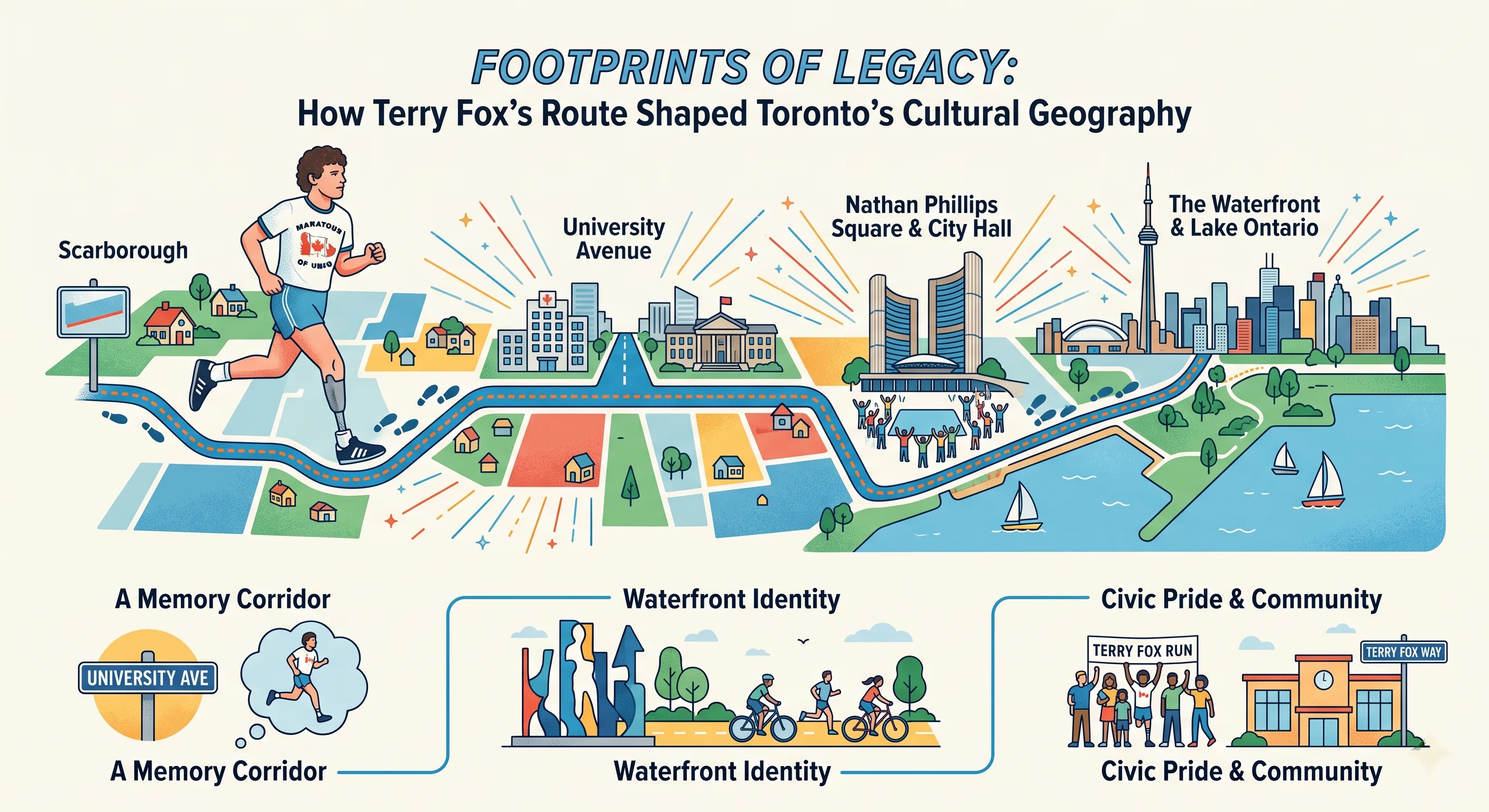
    Over time, the documented route, later public artworks, and annual community runs have connected ordinary streets and civic spaces to courage, hope, perseverance, and civic pride. Terry Fox’s passage through Toronto offers a way to read the city’s cultural geography, showing that neighbourhoods are not only shaped by buildings and infrastructure. They are also shaped by the stories people carry, the landmarks they honour, and the traditions they continue.

    For anyone thinking about where to live in Toronto, that idea matters. A neighbourhood is not only a collection of properties. It is a place with memory, movement, public space, and shared meaning.

    The Day Toronto Gathered for Terry Fox

    On July 10, 1980, Terry Fox recorded that ten miles of running had taken him into Metro Toronto in Scarborough. The following day, after an emotional reception at Scarborough Civic Centre, he ran to Nathan Phillips Square, where thousands of people cheered him on. The sequence is documented in the Terry Fox Foundation’s timeline.

    By then, his run had already become more than an athletic challenge. Terry had lost one leg to cancer and was running across Canada to raise awareness and funds for cancer research. His journey was physically punishing, but his message was clear. He wanted Canadians to care, to help, and to keep going.

    Toronto responded with emotion.

    Thousands gathered to see him. The city’s streets, normally defined by traffic and daily movement, became part of a national moment. As Terry made his way toward downtown, University Avenue became more than a corridor of hospitals, institutions, and office buildings. It became part of the path of a young man whose determination had captured the country.

    The City of Toronto identifies University Avenue as part of the route Fox followed into downtown before arriving at Nathan Phillips Square on July 11.

    Nathan Phillips Square became the emotional centre of that day. The square has always been one of Toronto’s most important civic spaces. It is where the city gathers for ceremonies, celebrations, protests, public announcements, and moments of shared identity. On that day, it became part of Terry Fox’s story too.

    “The physical space did not change, but the meaning of the space deepened.”

    That is how historic routes shape cities. They do not always leave behind a new building or a visible boundary. Sometimes they leave behind a memory that continues to live in the way people talk about a place.

    Tracing a Historic Corridor

    Historic paths allow us to see familiar places differently.

    Most people move through Toronto with practical concerns in mind. They think about traffic, TTC routes, walking distance, cycling lanes, commute times, and parking. University Avenue is a downtown corridor. Nathan Phillips Square is a civic landmark. Lake Shore Boulevard in Toronto and Lakeshore Road in Mississauga connect communities along the western side of Lake Ontario.

    But when these places are viewed through the lens of Terry Fox’s Marathon of Hope, they become more than infrastructure. They become part of a story.

    The available public record supports a high-level Toronto-area sequence rather than a complete turn-by-turn reconstruction:

    The July 10 and 11 sequence is supported by the Terry Fox Foundation and the City of Toronto. The July 13 passage through Mississauga is documented by Heritage Mississauga, which records that Fox left Toronto City Hall and followed Lakeshore Road through the city.

    This is not a complete street-by-street map, and it should not be read as one. It establishes major civic locations and the westward continuation through Mississauga without inventing turns or stopping points that the public record reviewed here does not identify.

    Terry’s Toronto-area passage connected Scarborough, downtown Toronto, and the western path through Mississauga. From civic centres and hospital corridors to suburban communities along Lakeshore Road, the Marathon of Hope passed through places that people still use every day. Each of those places keeps its everyday role while also carrying a memory layer:

    That is what makes the route so powerful. It did not exist outside ordinary life. It passed directly through it.

    This is the essence of cultural geography. A street is not only a street. It can also be a parade route, a protest route, a marathon route, a memory route, or a place where a community once gathered. Over time, those meanings sit beside the everyday use of the place.

    One later commemoration sits directly along the documented downtown corridor. In October 2022, a Terry Fox mural was completed at 500 University Avenue. It overlooks University Avenue, which the City identifies as part of the route Fox followed toward Nathan Phillips Square. The mural does not reconstruct his entire journey, but it makes the memory of his passage visible on a street he used.

    Toronto is constantly changing. New buildings rise, neighbourhoods intensify, and old corridors take on new uses. But historic memory gives the city continuity. It reminds us that even as the built environment changes, the stories attached to place can remain.

    The Waterfront as a Memory Corridor

    The waterfront deserves special attention because it is one of the clearest places where Toronto’s past, present, and future meet.

    Today, the waterfront is often associated with condo living, lake views, trails, parks, restaurants, cultural venues, public art, and access to downtown. It is one of the city’s most active public edges, used by residents, cyclists, runners, visitors, commuters, and families throughout the year.

    But the waterfront is not only a lifestyle setting. It is also a place where the city has chosen to preserve public memory.

    The historical route and the later waterfront commemoration need to be distinguished. Terry Fox’s documented westward passage through Mississauga followed Lakeshore Road on July 13, 1980. The sources used for this article do not establish 439 Queens Quay West as an exact stopping point or segment of his 1980 Toronto route.

    More than four decades later, Toronto’s waterfront became home to a permanent commemoration of his legacy. The Legacy Art Project opened in October 2023 at 439 Queens Quay West, east of the Toronto Music Garden and along the Martin Goodman Trail. It is a later tribute to the Marathon of Hope, not a historical route marker proving that Fox passed its present location.

    That distinction does not weaken the installation. It clarifies what the site represents.

    The project, titled We Are Shaped by the Obstacles We Face, was designed by artist Jon Sasaki in collaboration with DTAH. Sculpted granite slabs are positioned along a curving landscaped path. From one perspective, they appear as separate obstacles. From the west end of the installation, they align to form the silhouette of Terry Fox mid-stride.

    The design asks visitors to move through the space before the complete image is revealed. That experience reflects the meaning of Terry Fox’s story. His legacy was not created by avoiding hardship. It was created by continuing through it.

    The waterfront setting also gives the tribute an everyday quality. It is not hidden inside a building or separated from the life of the city. Someone can encounter it during a morning walk, a waterfront bike ride, a visit to the Toronto Music Garden, or a quiet moment by the lake.

    This is what public memory does best. It meets people where they already are.
    The Legacy Art Project

    Set along Queens Quay West beside the Toronto Music Garden, the Legacy Art Project honours Terry Fox with public art woven directly into waterfront life.

    For Harbourfront and the surrounding communities, this kind of landmark adds depth to neighbourhood life. It helps turn a dense urban area into a place people can experience on foot — part of a daily walk, a weekend ride, or a quiet moment by the lake.

    What you’ll find there
    • •“We Are Shaped by the Obstacles We Face” — carved granite forms along a curved path
    • •From the right viewpoint, the forms align into the silhouette of Terry Fox mid-stride
    • •The Toronto Music Garden directly beside it
    • •The Martin Goodman Trail running past — walk, run, or cycle through
    • •Free and open to everyone, all year round

    Physical Footprints and Civic Pride

    Some memories remain visible because a city chooses to make them visible. Terry Fox’s legacy is one of them.

    Across the Greater Toronto Area, his name and story appear in public art, road names, recreation spaces, schools, community events, and civic landmarks. These are not just symbolic gestures. They are ways of placing memory into the built environment.

    The Legacy Art Project is one of the most powerful examples. The installation, titled We Are Shaped by the Obstacles We Face, uses carved granite forms arranged along a curved path. From some angles, the forms appear as obstacles. From the right viewpoint, they align into the silhouette of Terry Fox mid-stride.

    The design asks visitors to move through the space before the full image is revealed. That experience reflects the meaning of Terry Fox’s story: his legacy was not created by avoiding hardship. It was created by moving forward through it.

    The impact is not simply about property values. It is about permanence, belonging, and recognition. In a fast-growing city, where the physical landscape can change quickly, civic memory gives neighbourhoods something steady to hold onto.

    A Living Legacy of Connected Communities

    Terry Fox’s legacy is not only preserved in public art and named places. It is renewed through action.

    Each year, Terry Fox Runs take place in communities across Canada, including neighbourhoods throughout Toronto. These events bring people together in parks, school grounds, waterfront paths, local streets, and community gathering spaces.

    That annual tradition matters because it turns memory into participation.

    “A monument asks people to remember. A run asks people to continue.”

    In neighbourhood terms, this is important. A community is not only defined by its housing stock, architecture, or transit access. It is also defined by the ways people gather, volunteer, support causes, and return to shared traditions.

    When a neighbourhood hosts an event such as a Terry Fox Run, public space is being used for more than movement. A park becomes a gathering point. A trail becomes a shared route. A local street becomes part of something larger than daily traffic.

    For people looking to put down roots, these are signals they may notice. They are not proof that every resident will experience the community in the same way:

    Traditions

    Annual events people return to

    Community runs, festivals, and shared causes — like the Terry Fox Run — can show that residents return to common activities year after year.

    Gathering

    Public spaces that bring people together

    Parks, squares, trails, and waterfronts can provide places for community life rather than serving only as routes from one destination to another.

    Participation

    Volunteer energy and local causes

    Neighbourhoods where residents organize, donate, and show up tend to feel more rooted and engaged.

    Continuity

    Stories carried forward

    Public art, plaques, road names, school events, and annual traditions can keep local memory available to newcomers and long-time residents alike.

    Community traditions can help answer a question many people only ask after they move in: does this neighbourhood feel connected?

    That is part of the living legacy of Terry Fox. It is not frozen in 1980. It continues every time people gather, walk, run, donate, volunteer, and carry the story forward.

    How Ordinary Streets Become Meaningful

    One of the most powerful lessons from Terry Fox’s route is that meaningful places are not always designed to be meaningful.

    A street does not need grand architecture to become important. A road does not need to be scenic to hold memory. A square does not become civic only because of its design. It becomes civic because people gather there.

    University Avenue already had institutional weight before Terry Fox travelled through it. It was lined with hospitals, public buildings, and major destinations. His passage added another layer, connecting the corridor with health, hope, courage, and public support.

    Nathan Phillips Square was already Toronto’s civic gathering place. The July 1980 reception became another moment in its long role as a place where Toronto comes together.

    The roads leading west toward Mississauga were already transportation corridors. Terry’s journey gave them a place in the Marathon of Hope story.

    These examples show that neighbourhood identity is built slowly. It comes from planning and architecture, but also from events, rituals, memory, and repetition. Over time, these layers shape how people experience place.

    A resident may not think about Terry Fox every time they pass University Avenue, Queens Quay, or Lakeshore Road. But the memory is still available. It can be recalled through a mural, a plaque, a public artwork, a road name, a school event, or an annual run.

    A location is where something is.
    A neighbourhood is what that place means to people.

    That emotional depth is part of what separates a location from a neighbourhood.

    What This Means for Real Estate and Neighbourhood Choice

    For a real estate audience, Terry Fox’s route should not be treated as a simple sales point. It would not be accurate or respectful to suggest that homes or condos along the path are worth more because of his legacy.

    The more meaningful point is that neighbourhoods are shaped by more than market data.

    Price, square footage, transit, schools, building amenities, maintenance fees, and commute times all matter. But buyers and renters are also choosing a daily environment. They are choosing the streets they walk, the parks they visit, the landmarks they pass, the public spaces they share, and the stories attached to the area.

    Historic paths help reveal those stories. Terry Fox’s route shows how civic memory can live inside everyday urban space. It reminds us that a neighbourhood can have emotional, cultural, and communal value, not only financial value.

    This is especially relevant in Toronto, where many communities are changing quickly. New condo towers can appear in a few years. Retail strips can evolve. Transit routes can shift. Public memory can give a place continuity and help residents feel that they are part of something larger than one building, one transaction, or one moment in the market.

    These are not simple price factors. They are quality-of-life considerations, and different buyers and renters will value them differently.

    The True Fabric of a Neighbourhood

    Toronto’s neighbourhoods are often described by their built form.

    Harbourfront is associated with waterfront living, trails, public spaces, and lake access. University Avenue is known for hospitals, institutions, and downtown movement. Nathan Phillips Square is known for City Hall and civic gatherings. Mississauga’s Lakeshore communities are connected to Lake Ontario and have evolved from older village patterns into parts of a larger urban region.

    But each of these places also carries stories.

    Terry Fox’s Marathon of Hope is one of those stories. His documented passage brought people together in Scarborough, along University Avenue, at Nathan Phillips Square, and later along Lakeshore Road through Mississauga. The memory has continued through public art, civic landmarks, named places, school events, and annual community runs.

    That is why historic paths matter. They remind us that a neighbourhood is not only a place to buy, rent, commute from, or invest in. It is a place where life happens and where memory accumulates.

    The enduring character of a community is found not only in its architecture or proximity to transit. It can also be found in its shared stories, active traditions, and public spaces that invite people to remember together.

    Terry Fox’s route through Toronto did not change the city’s physical grid.

    It changed the way the city could remember itself.

    Walk the route for yourself

    Visit the Legacy Art Project at 439 Queens Quay West — free, open year-round, beside the Toronto Music Garden along the Martin Goodman Trail. It is a later waterfront commemoration of Terry’s legacy, not a turn-by-turn marker of his documented 1980 route.

    Explore the Legacy Art Project
    Editorial Disclaimer & Legal Notice
    Editorial Note: This article provides general information for Canadian homebuyers, with additional Ontario-specific information. It is an educational overview and does not reflect the specifics of any individual transaction.The information in this article is provided for general educational purposes only. Deposit practices, trust rules, mortgage requirements and consumer protections vary by province, lender, insurer and transaction. Nothing here should be interpreted as legal, mortgage, financial or tax advice.Deposit amounts and deadlines are set by the Agreement of Purchase and Sale, and mortgage approval is determined by the lender and, where applicable, the mortgage insurer. Buyers should review their agreement carefully and obtain advice from a licensed real estate professional, a real estate lawyer, a mortgage professional and a tax professional where appropriate.
    FA

    About the author:

    Faiza Ahmed

    As the founder of PropertyMesh, Faiza Ahmed is dedicated to making real estate more transparent and cost-effective. While she advocates for more transparent, flexible fee structures so sellers can keep more of their equity, her core focus is empowering buyers and sellers to make informed decisions. Faiza is a licensed real estate broker registered with the Real Estate Council of Ontario (RECO Registration #4791581) and an active member of the Toronto Regional Real Estate Board (TRREB).

    Follow the expert:LinkedIn
    Crowd gathered at Nathan Phillips Square in Toronto
    Image Source: terryfox.org
    DateDocumented Toronto-area movementSource
    July 10, 1980Fox completed ten miles that took him into Metro Toronto, recorded in his timeline under Scarborough.Terry Fox Foundation
    July 11, 1980After a reception at Scarborough Civic Centre, he continued toward downtown along University Avenue and ran to Nathan Phillips Square.Terry Fox Foundation; City of Toronto
    July 13, 1980Fox departed Toronto City Hall and continued west through Mississauga along Lakeshore Road, passing through Port Credit, Lorne Park, and Clarkson.Heritage Mississauga
    Place along the routeIts everyday roleIts memory layer
    University AvenueCorridor of hospitals, institutions, and downtown movementPart of the path of the Marathon of Hope, connected to health, hope, and courage
    Nathan Phillips SquareToronto’s civic gathering place for ceremonies and celebrationsThe emotional centre of the July 1980 reception for Terry Fox
    Queens Quay & The Waterfront (Lakeshore Road)Trails, parks, condos, and daily lakefront lifeA memory corridor where Terry’s legacy has a permanent public presence
    Roads leading West toward MississaugaCommuter and transportation corridorsThe route that carried the Marathon of Hope onward through the GTA