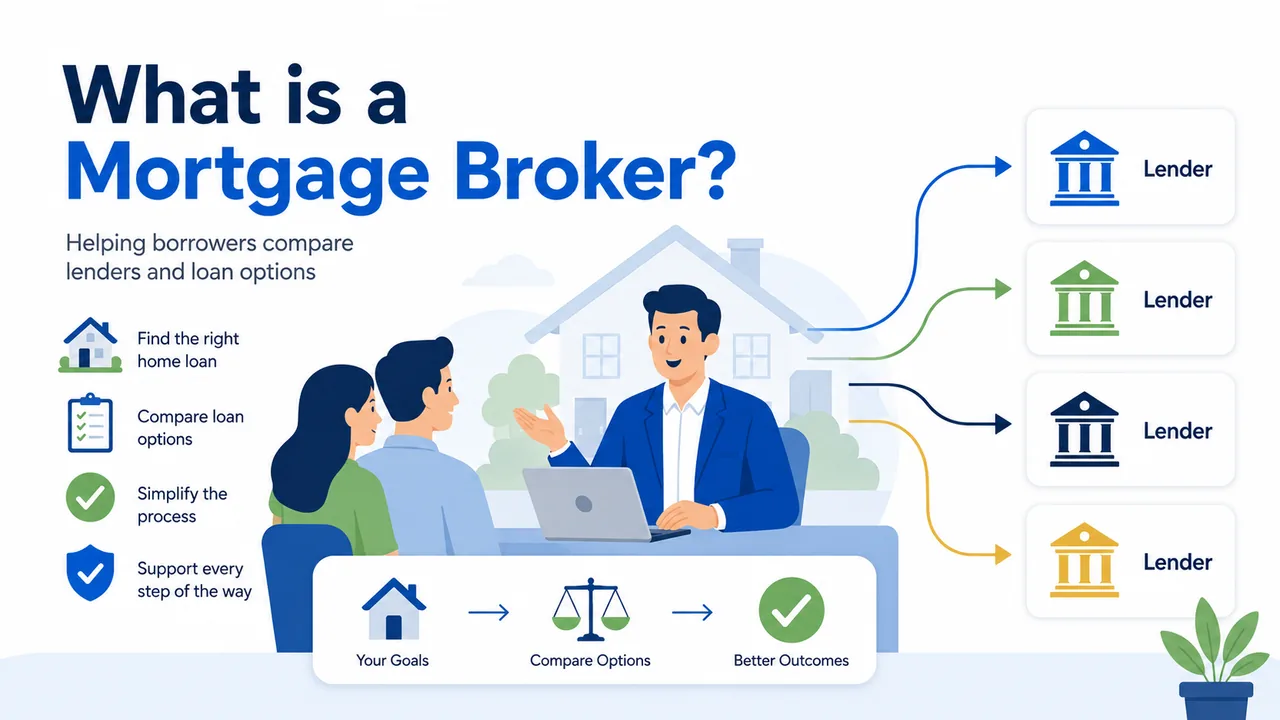
What is a Mortgage Broker?
A mortgage broker shops multiple lenders on your behalf and is typically paid by the lender, not you. How brokers work and when one can save you money.
FA
Written by Faiza Ahmed
Last updated on August 14, 2026
A mortgage broker shops multiple lenders on your behalf and is typically paid by the lender, not you. How brokers work and when one can save you money.
Written by Faiza Ahmed
Last updated on August 14, 2026
This content is published by PropertyMesh.ca for educational purposes only. It is not legal, financial, tax, or mortgage advice. PropertyMesh.ca is NOT a brokerage or lender. Our real estate content is supervised by licensed Ontario real estate broker Faiza Ahmed (RECO #4791581) through International Realty Firm, Inc. A real estate licence is not a mortgage-broker licence. Always consult an appropriately authorized mortgage professional for personalized loan advice.
When buying a home in Canada, one of the most important decisions is how you’ll finance it. Many people go directly to their bank, but there’s another professional who can help you navigate the process: a mortgage broker. Understanding who they are, how they’re regulated, and how they get paid is crucial for making an informed choice.
A mortgage broker is a professional who acts as an intermediary between borrowers (you) and lenders (banks, credit unions, mortgage finance companies, or private lenders). Their role is to help you find a mortgage product that suits your financial situation and goals. Unlike a bank mortgage specialist, who can only offer that bank’s products, brokers may have access to multiple lenders and can “shop around” within their lender panel on your behalf. Brokers do not all have access to the same lenders, and some lenders offer products only through their own channels. Titles and authorization requirements vary by jurisdiction. In Ontario, you may work with a licensed Mortgage Agent who operates under the supervision of a Mortgage Broker at a licensed Brokerage; other jurisdictions use different titles. For consumer purposes, the term “broker” is often used to describe the professional helping you.
Mortgage-broker licensing, registration, and consumer-protection rules vary by province or territory. Before signing any documents, use the official registry where one exists. Where there is no dedicated public mortgage-broker registry, contact the listed government office rather than treating a general business directory as proof of authorization.
| Province / Territory | Regulator | Public Registry / Info | Notes |
|---|---|---|---|
| Ontario | Financial Services Regulatory Authority of Ontario (FSRA) | FSRA mortgage registry | Verify both the individual and the brokerage. |
| British Columbia | BC Financial Services Authority (BCFSA) | Find a Mortgage Broker | The current register lists mortgage brokers and submortgage brokers. A new licensing regime is scheduled for October 13, 2026. |
| Alberta | Real Estate Council of Alberta (RECA) | RECA ProCheck search | Search professionals and brokerages. |
| Quebec | Autorité des marchés financiers (AMF) | AMF register | Quebec has distinct licence classes. |
| Saskatchewan | Financial and Consumer Affairs Authority (FCAA) | Licensed brokerages & associates | Public list; contact Consumer Credit Division for help. |
| Manitoba | Manitoba Securities Commission (MSC), Real Estate Division | Search registrants | Search the mortgage broker, authorized official, or salesperson, as applicable. |
| New Brunswick | Financial and Consumer Services Commission (FCNB) | FCNB Search | Use FCNB's public search portal to verify status. |
| Nova Scotia | Service Nova Scotia | Mortgage brokers and associate mortgage brokers | Use the public list to verify licence status. |
| Prince Edward Island | Justice & Public Safety, Financial and Consumer Services Division | Government directory | No dedicated public mortgage-broker registry was identified; ask the division which rules and verification route apply. |
| Newfoundland & Labrador | Consumer and Financial Services | Valid mortgage broker licences | The province publishes lists of licensed mortgage brokers and brokerages. |
| Yukon | Professional Licensing and Regulatory Affairs | Government contact | Mortgage brokers are not listed in the current regulated-professions list; ask which rules and verification route apply. |
| Northwest Territories | Municipal & Community Affairs (MACA) / Consumer Affairs | Consumer Affairs Info | No dedicated public mortgage-broker registry was identified; ask Consumer Affairs which rules and verification route apply. |
| Nunavut | Department of Community Services / Consumer Affairs | Consumer Affairs contact | No dedicated public mortgage-broker registry was identified; ask Consumer Affairs which rules and verification route apply. |
Consumer Tip: Ask your broker for their authorization or registration number and brokerage name where the local system issues them, then confirm both using the official registry. Otherwise, contact the listed government office directly.
Independent Mortgage Brokers
These professionals are not employed by a specific bank. Instead, they work with a network of lenders and can compare multiple mortgage products available within their lender panel to find the best match for the client. Their independence often allows more flexibility in tailoring products to different income levels, credit histories, or down payment amounts.
Mortgage Specialists at Banks
Sometimes confused with brokers, mortgage specialists work directly for one financial institution. They can only offer that bank’s mortgage products. While convenient if you already bank there, their options are limited compared to the options a broker’s lender panel may provide.
It’s important to clarify whether you’re dealing with an authorized mortgage professional or a bank representative, as the obligations and range of products differ.
In most cases, mortgage brokers in Canada are paid by the lender, not the borrower. This compensation is called a finder’s fee or commission and is based on the size and type of mortgage.
Standard Residential Mortgages: Lenders typically pay brokers a commission; the amount varies by lender, product, term, and incentives.
Renewals and Transfers: Commissions vary by lender — some pay a reduced or trailer fee at renewal, while others pay nothing, especially when you renew directly with your existing lender.
Private or Complex Mortgages: Sometimes the borrower may pay a fee directly, especially for higher-risk loans or situations where traditional lenders are not an option.
⚠️ Disclosure Obligation: Rules vary by jurisdiction and transaction. Ask in writing how the broker is compensated, whether you must pay any fee, and whether lender relationships or incentives affect the options presented.
Mortgage-broker duties vary by jurisdiction and by whom the brokerage represents. Ask whether the brokerage represents you, the lender, or both where permitted. Depending on the applicable rules, duties may include:
Recommending a suitable product and following any duty owed to the client; a borrower-facing fiduciary or best-interest duty should not be assumed in every jurisdiction or transaction.
Disclosing fees, potential conflicts of interest, and relationships with lenders as required.
Explaining the terms, conditions, and material risks of the mortgage.
Following compliance standards set by the applicable regulator.
Access to Multiple Lenders – Brokers can compare rates and products across the lenders available to them.
Expert Guidance – They help explain terms like fixed vs. variable rates, prepayment penalties, and amortization periods.
Support for Complex Cases – Borrowers with self-employment income, lower credit scores, or unique circumstances may benefit from a broker’s wider network.
Convenience – Brokers handle much of the paperwork and communication with lenders.
This is an illustrative workflow. The contract, lender, mortgage insurer, appraiser, lawyer or Quebec notary, real estate professional, and borrower may control different tasks and deadlines.
A Complete Timeline from Discovery to Post-Closing
| Phase & Timing | What the Broker Does | Why It Matters | Your Action Items |
|---|---|---|---|
1 Discovery & Goal-Setting Weeks to Months Before You Shop |
| Early triage prevents avoidable declines and helps you target properties you can actually complete. |
|
2 Pre-Qualification vs. Pre-Approval Before House Hunting |
| A pre-approval may help establish a budget and hold a rate, but it does not guarantee final mortgage approval. The lender must still approve the property, documents, and remaining conditions. |
|
3 Offer Strategy & Condition Windows While You Bid |
| Some files fail on property quirks or unverifiable down payments, not borrower income. Advance checks can save deals. |
|
4 Full Application & Underwriting After Offer Acceptance |
| Speed and completeness reduce price-hold slippage and appraisal-related delays. |
|
5 Commitment, Conditions & Legal Instructions Conditions Period |
| Penalty math and portability determine your real cost of ownership if you move or refinance before maturity. |
|
6 Closing Preparation Before Closing |
| Most last-minute issues are operational. Proactive coordination can prevent “funding day” surprises. |
|
7 Post-Funding Support After You Get the Keys |
| A broker may provide ongoing support, but the services offered vary. |
|
Early triage prevents avoidable declines and helps you target properties you can actually complete.
A pre-approval may help establish a budget and hold a rate, but it does not guarantee final mortgage approval. The lender must still approve the property, documents, and remaining conditions.
Some files fail on property quirks or unverifiable down payments, not borrower income. Advance checks can save deals.
Speed and completeness reduce price-hold slippage and appraisal-related delays.
Penalty math and portability determine your real cost of ownership if you move or refinance before maturity.
Most last-minute issues are operational. Proactive coordination can prevent “funding day” surprises.
A broker may provide ongoing support, but the services offered vary.
These are industry shorthand, not statutory categories, and lender criteria vary.
A-Lenders (banks, large credit unions, monolines): Often competitive rates, stricter underwriting, and products for borrowers who meet the lender’s criteria.
B-Lenders (alternative): More flexible on credit/income; higher rates/fees may apply; any transition plan should be based on your actual circumstances and future qualification.
Private/MIC: May place more weight on property value or equity; short terms and borrower-paid fees are common; used for some unique properties, credit challenges, or urgent timing.
Your broker should explain why a given tier is recommended, how long you’re expected to remain there, and the cost to transition.
Who pays: Typically the lender on prime (A) deals; you may pay on B/private.
What you’ll see in writing: Ask for the compensation method, any borrower-paid broker or lender fees, relevant incentives, and lender relationships.
When you pay: Review the written service or fee agreement and closing documents; timing and payment mechanics vary.
If the mortgage does not fund: Do not assume every unfunded file is fee-free. Check the agreement and applicable rules before signing.
Licensing: Verify the broker and brokerage using the registries listed above.
Written disclosures: Compensation, conflicts, lender relationships, and product limitations should be disclosed as required by the applicable rules.
Consent & privacy: Expect signed consent for credit pulls and clear data-handling practices.
Complaints & escalation: Ask for the brokerage’s complaint process and the appropriate regulator or government contact for your jurisdiction.
Pressure to waive financing because you have a pre-approval.
Vague answers about penalty formulas or prepayment rights.
Refusal to specify who pays the broker and how much.
Promises of “guaranteed approvals” without documents.
Asking you to misstate income, debts, or occupancy (walk away).
Verify authorization using the applicable official registry or government contact.
Get a lender pre-approval and a rate hold in writing, but remember that neither is final approval.
Understand insured/insurable/uninsurable status and how it affects your rate.
Review the commitment with your broker: penalties, prepayments, portability.
Confirm who pays fees (and how much) before you waive conditions.
Keep finances stable until keys in hand; respond to document requests promptly.
Book an annual post-funding review.
If you prefer an existing relationship with your bank.
If the bank offers special loyalty perks, bundled discounts, or pre-approved rates.
If you want all your financial products (savings, mortgage, loans) with one provider.
A mortgage broker in Canada helps borrowers seek financing from the lenders available through the broker’s network. Authorization, representation duties, and disclosure rules vary by province or territory, and compensation often comes from the lender rather than the borrower. Before working with one, confirm the individual’s and brokerage’s authorization where applicable, whom the brokerage represents, which lenders are included, how the broker is paid, and the mortgage’s conditions and total cost.
About the author:
Faiza Ahmed
As the founder of PropertyMesh, Faiza Ahmed is dedicated to making real estate more transparent and cost-effective. While she advocates for more transparent, flexible fee structures so sellers can keep more of their equity, her core focus is empowering buyers and sellers to make informed decisions. Faiza is a licensed real estate broker registered with the Real Estate Council of Ontario (RECO Registration #4791581) and an active member of the Toronto Regional Real Estate Board (TRREB).