

3. The Math Behind the Results
Your calculator results are broken into four lines:
- Commission
- Legal fees
- Tax on those services
- Mortgage penalty
Then it shows one combined figure: Total Deducted. Here’s how each part is calculated.
Commission
For most provinces (flat structure):
Commission = Sale Price x (Commission Rate ÷ 100)
For British Columbia and Alberta (Common Tiered Examples):
- 7% on the first $100,000 of the price
- The rate you choose (the “balance rate”) on the remainder
Disclaimer: Commission rates and structures are not set by law; they are negotiable and vary by brokerage and agent.
For Saskatchewan (Common Tiered Example):
- 6% on the first $100,000
- 4% on the second $100,000
- The chosen balance rate on anything above $200,000
These patterns reflect common brokerage structures in those markets, but you are free to adjust the rates to match your specific agreement.
Taxable amount and sales tax
Only commission + legal fees are taxed.
Taxable Amount = Commission + Legal Fees
Based on your province selection, the tool multiplies that figure by the appropriate tax rate (GST, HST, QST, or combined provincial taxes) and shows the result in the “Tax” line.
Mortgage penalty
The penalty number you enter is displayed separately and not taxed in the calculation. It’s treated as its own line item.
Total deducted
Total Deducted = Commission + Legal Fees + Condo Estoppel/Status Cert + Tax + Mortgage Penalty + Discharge Fee
This is the number most sellers care about: the combined closing costs that will come out of their sale proceeds.
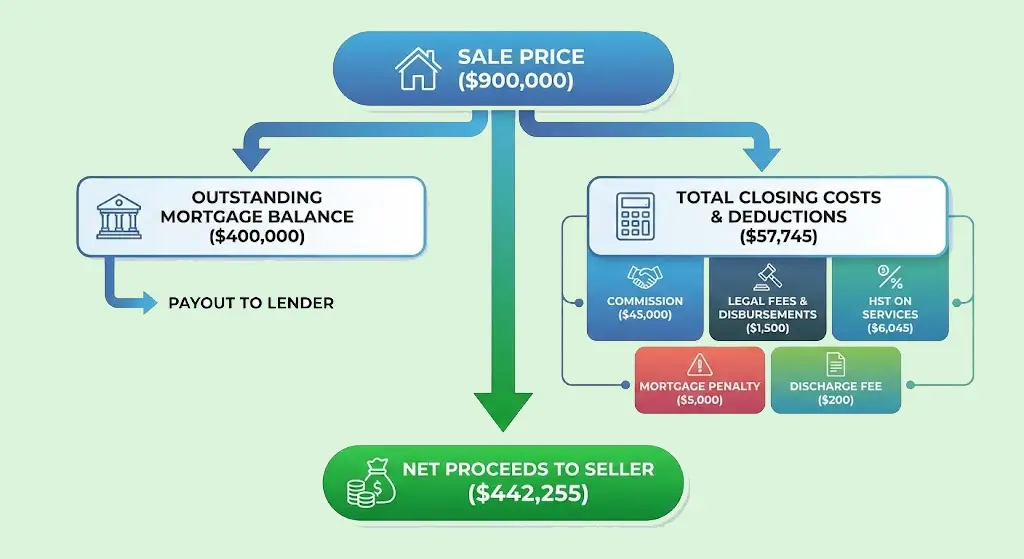
4. Example Walkthrough
Here’s a simplified example so you can see how the numbers fit together.
Scenario:
- Property Type: Single Detached House
- Province: Ontario
- Expected sale price: $900,000
- Commission rate: 5%
- Legal fees: $1,500
- Condo Estoppel/Status Cert: $0
- Mortgage penalty: $5,000
- HST: 13%
- Commission
$900,000 x 5% = $45,000
- Taxable amount (commission + legal fees)
$45,000 + 1,500 = $46,500
- HST on taxable amount
$46,500 x 13% = $6,045
- Total deducted
- Commission: $45,000
- Legal fees: $1,500
- HST: $6,045
- Mortgage penalty: $5,000
- Mortgage discharge fee: $200
- Total deductions = $57,745
- Net proceeds
Sale Price – Total Deductions – Mortgage Balance: $900,000 – 57,745 – 400,000 = $442,255
The calculator shows the “Total deducted” portion; you or your advisor can then subtract your outstanding mortgage for a full net figure.
5. What the Tool Covers – and What It Doesn’t
Included in the calculation:
- Real estate commission (flat or tiered, depending on province inputs)
- Legal or notary fees (based on your entry)
- GST/HST/PST/QST on those services
- Any mortgage penalty (entered by you)
- Discharge Fee (assumes $200)
- Condo estoppel/status certificate – (entered by you for condo owners)
Not automatically included:
Some costs are highly variable or paid before closing, so they’re not baked into the formula:
- Staging, photography, or virtual tours: Often paid upfront.
- Repairs and pre-listing renovations.
- Moving expenses.
- Property tax, condo fee, or utility adjustments: These are calculated to the exact day of closing.
- Capital gains tax: Only applicable on investment properties or secondary residences (not your primary home).
You can still use the calculator output as a base and then add any of these items separately in your own budgeting.
6. Why Closing Costs Vary Across Canada
Even with a national overview, selling costs are not identical from province to province. A few reasons:
- Different tax systems: Some provinces use HST, some use GST plus a provincial sales tax (PST/RST/QST), and the rates differ. Furthermore, some provinces tax legal fees and commissions differently.
- Commission structures: Tiered models are more common in certain Western provinces, while others primarily use a flat percentage.
- Professional fees: Whether you are working with a lawyer or a notary, and local market norms, will affect the quote you receive.
That’s why the first step in the tool is selecting your province. It ensures that the tax piece of your estimate is roughly aligned with how your region works.
7. Common Surprises for Sellers
Even careful sellers are sometimes caught off guard by a few items:
- Higher-than-expected mortgage penalties when breaking a fixed term.
- Tax on services (commission and legal fees) that was never factored in mentally.
- Small administrative charges from lenders and law offices.
- Condo-specific charges such as elevator bookings or status certificate delays.
Using the calculator forces you to think about these line items up front instead of discovering them a week before closing.
8. Frequently Asked Questions
Q: Does this tool tell me my exact net proceeds?
A: It tells you the combined deductions related to commission, legal fees, tax on those services, and any penalty you enter. To estimate net proceeds, subtract that total and your mortgage balance from your expected sale price.
Q: Can I use it if I’m selling a condo instead of a house?
A: Yes. The math is the same for condos, townhouses, semis and detached homes. You just plug in the realistic sale price and your expected fee structure.
Q: What if my commission structure is different from the presets?
A: You can adjust the commission rate for the “balance” portion, or choose the custom option if you’re working with an unconventional agreement. The tool is flexible enough for most real-world scenarios.
Q: Are all seller costs included?
A: No. The focus is on major, predictable items: commission, legal, tax on those, and penalties. Things like staging, repairs, and moving are left out so you can add them based on your own plans.
Q: Is this a substitute for legal or tax advice?
A: No. It’s a planning tool. For final numbers, you should confirm with your lender, lawyer/notary, and tax professional.
9. Important Reminder and Disclaimer
Real estate transactions are regulated, and the financial impact of selling a property can be significant. This calculator and guide are provided for general information only. They do not replace professional advice from a licensed real estate agent, lawyer or notary, mortgage professional, or tax advisor.
Actual closing costs will depend on the terms of your listing agreement, your mortgage contract, provincial rules, and the professionals you hire. Always verify your expected numbers with the relevant parties before making decisions about listing or accepting an offer.